Back to Concerts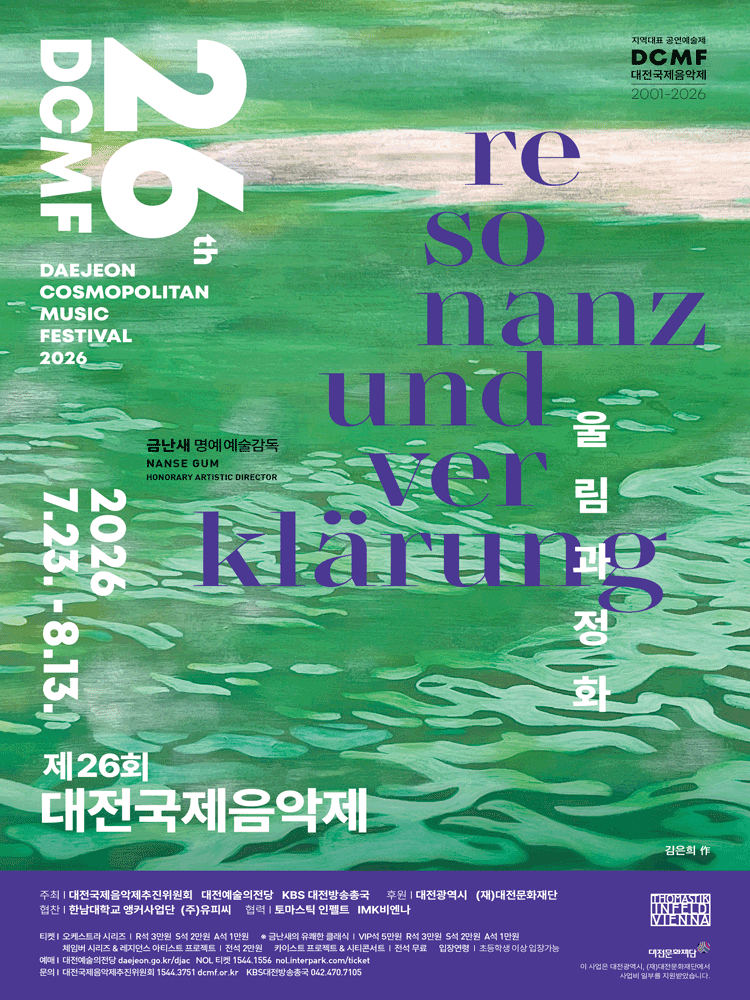
![SunnyTen [Daejeon]](https://www.kopis.or.kr/upload/pfmPoster/PF_PF263000_250811_154517.gif)
![The Snail Bride [Daejeon]](https://www.kopis.or.kr/upload/pfmPoster/PF_PF291644_260529_162645.jpg)
![The Big Fart [Daejeon]](https://www.kopis.or.kr/upload/pfmPoster/PF_PF291054_260511_125336.gif)
![MBC Late Night Ghost Story x NiniKids: Survive at School [Daejeon]](https://www.kopis.or.kr/upload/pfmPoster/PF_PF290936_260508_130844.gif)
ConcertUpcoming
26th Daejeon International Music Festival, Extremes and Everything In Between
제26회 대전국제음악제, 극한과 그 사이의 모든 것
Aug 7, 2026
Daejeon Arts Center (Art Hall)대전예술의전당 (아트홀)
About
[PROGRAM INTRODUCTION]
Residency Program II
This program traverses the furthest polarities inherent in music, exploring the human emotions and the texture of time that fill the space between them. Through a musical journey that crosses the gaps between extremes, it asks how tradition and modernity, simplicity and complexity, darkness and light can be connected as a single continuum. From the primal voice of folk tradition to the intense tension of the Baroque, the condensed sorrow of the Renaissance and contemporary reflection, and finally to the bright vitality of Classicism, different eras and aesthetics resonate with and reflect one another on a line of continuity rather than discontinuity.
Telemann's Concerto for solo viola and string orchestra in G Major TWV 51:G9 is one of the most significant existing Baroque viola concertos, a work that elegantly and vividly reveals the warm timbre and technical brilliance of the viola. Through four movements, it offers lyricism, vitality, and the characteristic balance of the Baroque era. Bach's Concerto for solo violin, strings, and continuo in D minor BWV 1052R, which follows, is known to be a reconstruction of a lost original violin concerto. It demonstrates the essence of the Baroque concerto through intense energy, meticulous counterpoint, and dramatic contrast. This is followed by Dowland's "If My Complaints Could Passions Move." A representative song of the Renaissance era, this work captures the emotion of unrequited love and profound loss within a restrained melody, conveying a resonance that transcends time. Britten's "Lachrymae" (Reflections on a Song of Dowland) Op. 48a that follows is a work connecting past and present based on Dowland's melody. Through modern harmony and delicate variations, it illuminates the emotion of the original work from a fresh perspective while maximizing the deep and rich expressiveness of the viola. Finally, Schubert's Rondo in A Major D.438 provides a bright conclusion to the program, contrasting with the dark and introspective sentiment of the preceding works. Based on deep reverence for Mozart and the folk spirit of Vienna, this work encompasses classical balance and Romantic lyricism, celebrating hope and joy in life. Born from different eras and languages, these works ultimately demonstrate that tradition and innovation, sorrow and joy, past and present can coexist within a single continuum.
[PROGRAM]
G. P. Telemann / Concerto for solo viola and string orchestra in G Major TWV 51:G9
I. Largo
II. Allegro
III. Andante
IV. Presto
J. S. Bach / Concerto for solo violin, strings, and continuo in D minor, BWV 1052R
I. Allegro
II. Adagio
III. Allegro
Intermission
J. Dowland / "If My Complaints Could Passions Move" for solo viola and strings
B. Britten / "Lachrymae" (Reflections on a Song of Dowland) for solo viola and strings, Op. 48a
F. Schubert / Rondo for solo violin and strings in A Major, D.438
*The above program is subject to change at the discretion of the organizers.
Location
Daejeon Arts Center (Art Hall)대전예술의전당 (아트홀)
See all events at Daejeon Arts Center (Art Hall) →
대전광역시 서구 둔산대로 135 (만년동)
More concerts in Daejeon
View allConcertMusicalOngoing
SunnyTen [Daejeon]
May 9, 2025 — Aug 30, 2026
London Stage [Daejeon Jung-gu], Daejeon
ConcertMusicalOngoing
The Snail Bride [Daejeon]
Jun 11, 2026 — Jul 12, 2026
Joymaru Art Hall, Daejeon
ConcertMusicalUpcoming
The Big Fart [Daejeon]
Jul 11, 2026
Daejeon Pyeongseong Youth Culture Center (Eoul-lim Hall (Small Theater)), Daejeon
ConcertMusicalUpcoming
MBC Late Night Ghost Story x NiniKids: Survive at School [Daejeon]
Jul 11, 2026 — Jul 12, 2026
Hanbat National University (Art Hall (Harmony Hall)), Daejeon
![Snow White [Daejeon]](https://www.kopis.or.kr/upload/pfmPoster/PF_PF291584_260518_110125.jpg)
![N-bunal Tour Concert: HIGHTENSION [Daejeon]](https://www.kopis.or.kr/upload/pfmPoster/PF_PF294152_260619_140825.jpg)