Back to Concerts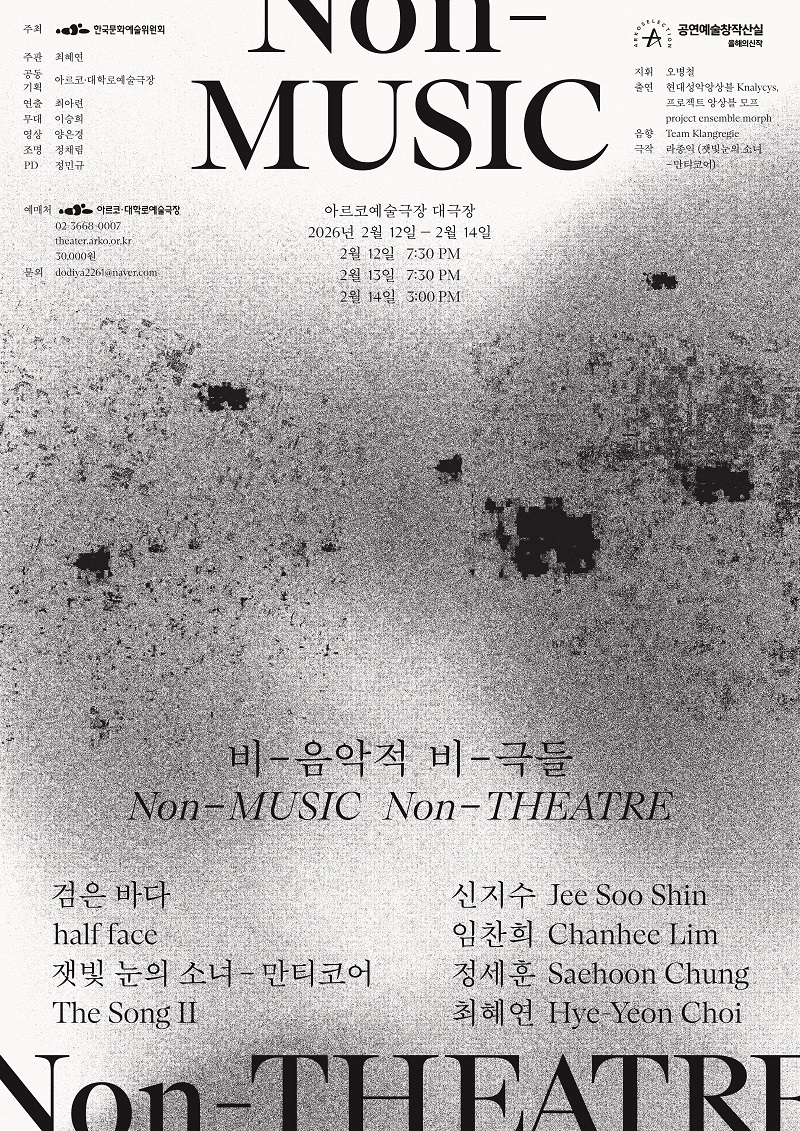
![Nanta [Myeongdong]](https://www.kopis.or.kr/upload/pfmPoster/PF_PF235543_251014_140238.gif)

![Someday [Daehakro]](https://www.kopis.or.kr/upload/pfmPoster/PF_PF236674_250602_133202.gif)
![Pinocchio, Let's Go! [Daehangno]](https://www.kopis.or.kr/upload/pfmPoster/PF_PF235879_260609_134815.gif)
![Painters [Kyunghyang Art Hill]](https://www.kopis.or.kr/upload/pfmPoster/PF_PF237479_260518_151643.gif)
ConcertEnded
Creative Workshop, Choi Hye-yeon: Non-Musical Non-Plays
창작산실, 최혜연: 비-음악적 비-극들
Feb 12, 2026 — Feb 14, 2026
Arco Art Theater (Small Theater)아르코예술극장 (소극장)
About
[SYNOPSIS]
Four composers create music on tragic themes, questioning essential human emotions in the space between tragedy and non-tragedy.
Work 1: Black Sea (Composed by Shin Ji-soo)
[Setting] Inside the cabin of the Yonggeumho vessel in August 1973, shrouded in pitch-black darkness. A confined space where only the sound of damp wooden floors and rusted chains can be heard.
Character: Kim Dae-jung (Tenor)
[Situation] The kidnapped "Mr. Kim Dae-jung" lies on a cold floor with his eyes covered and limbs bound. The ship's engine vibrations echo irregularly like a heartbeat, while the intermittent sound of waves seems like a harbinger of impending death. He senses the cold sea that will soon swallow him whole and pours out human anguish suppressed at the threshold between life and death. Through an extremely repressed voice, he sings of invisible fear and physical pain, fragmented memories and dread surfacing as death approaches, remorse for the family left behind, confused emotions intertwined with unbreakable conviction, and the emptiness and desolation of awaiting an unknowable death.
Work 2: half face (Composed by Lim Chan-hee)
I. The Face of Meaning
II. The Face of Meaninglessness
half face is a work about human division and incompleteness, and diversity and identity. Through the symbolism of half a face, it examines emotional, physical, psychological, and cultural-moral duality. It acknowledges our incompleteness in failing to respect each other's differences as complete diversity. We accept that we now live in an age of discrimination beyond difference, anger and hatred beyond conflict. Accept? Is there hatred beyond love? Is there love beyond hatred? We examine the countless humanity residing within my face. We listen. Through the meeting of my half face and that of the other.
Work 3: The Song II (Composed by Choi Hye-yeon)
Bags lie on the floor. Some are garbage, others envelopes. In the moment of hesitation over the distinction, identity moves between objects and perspective. Is the voice on stage a song or noise? An attempt to speak or a trace already abandoned in failure? Breath breaks, breathing becomes exaggerated, and whispers and silence remain in the space with equal weight. Each person sings their own love and lives earnestly toward something. They waver, become frustrated, break, and fall. Was it achieved? In a place where nothing is visible and nothing is felt, we refocus. Breath accumulates, and a rhythmic reverberation like a heartbeat slowly fills the space.
Work 4: The Gray-Eyed Girl—Manticore (Composed by Chung Se-hun)
The Manticore is a monster that seduces the strong to perish together. Wearing the emptiness of the wounded girl Elissa, it seeks out Theophilus, a specimen of ruin, and together sinks into eternal void.
ACT I: The False Paradise and the Broken Jar
4th century BCE, the kingdom of Tyre on the brink of collapse from Alexander the Great's invasion. King Azemilkos appoints a petty thief Eshmun who resembles him and an albino woman Anat as stand-ins for his escape. During a theatrical performance for survival, Anat feeds her own daughter a near-lethal poison. Having survived the madness of war, she hides away with her disabled daughter Elissa.
Confined to the attic, Elissa yearns for the outside world, but her mother controls her consciousness, saying "You are weak and cannot leave anyway." Elissa realizes that parents, people, and even invaders have all killed each other for survival and greed, and falls into deep emptiness. Through this gap seeps an ancient being, the Manticore, and Elissa surrenders her body to be reborn as Lise, the girl with gray eyes.
ACT II: The Broken Hero and the Gray-Eyed Girl
A distant future. The boy Theo is abused by his deranged mother Agnes and witnesses the murder and suicide of his half-siblings firsthand. Having lost his identity to trauma, he is remodeled by national institutions into the superhero Theophilus and consumed for humanity. All that remains after endless obedience and sacrifice are ridicule and betrayal.
Pursued by earthlings and falling across time and space to medieval Tyre, Theophilus meets Lise, who has sought him for thousands of years. Lise, revealing humanity's greed, slaughters the villagers; Theo, raging with anger, runs wild. In the final moment, the Manticore does not refuse his destruction but embraces it. The most burning anger and the coldest void meet, and the two beings sink together into eternal rest.
More concerts in Seoul
View allConcertMusicalOngoing
Nanta [Myeongdong]
Dec 2, 2021
Myeongdong Nanta Theater, Seoul
ConcertMusicalOngoing
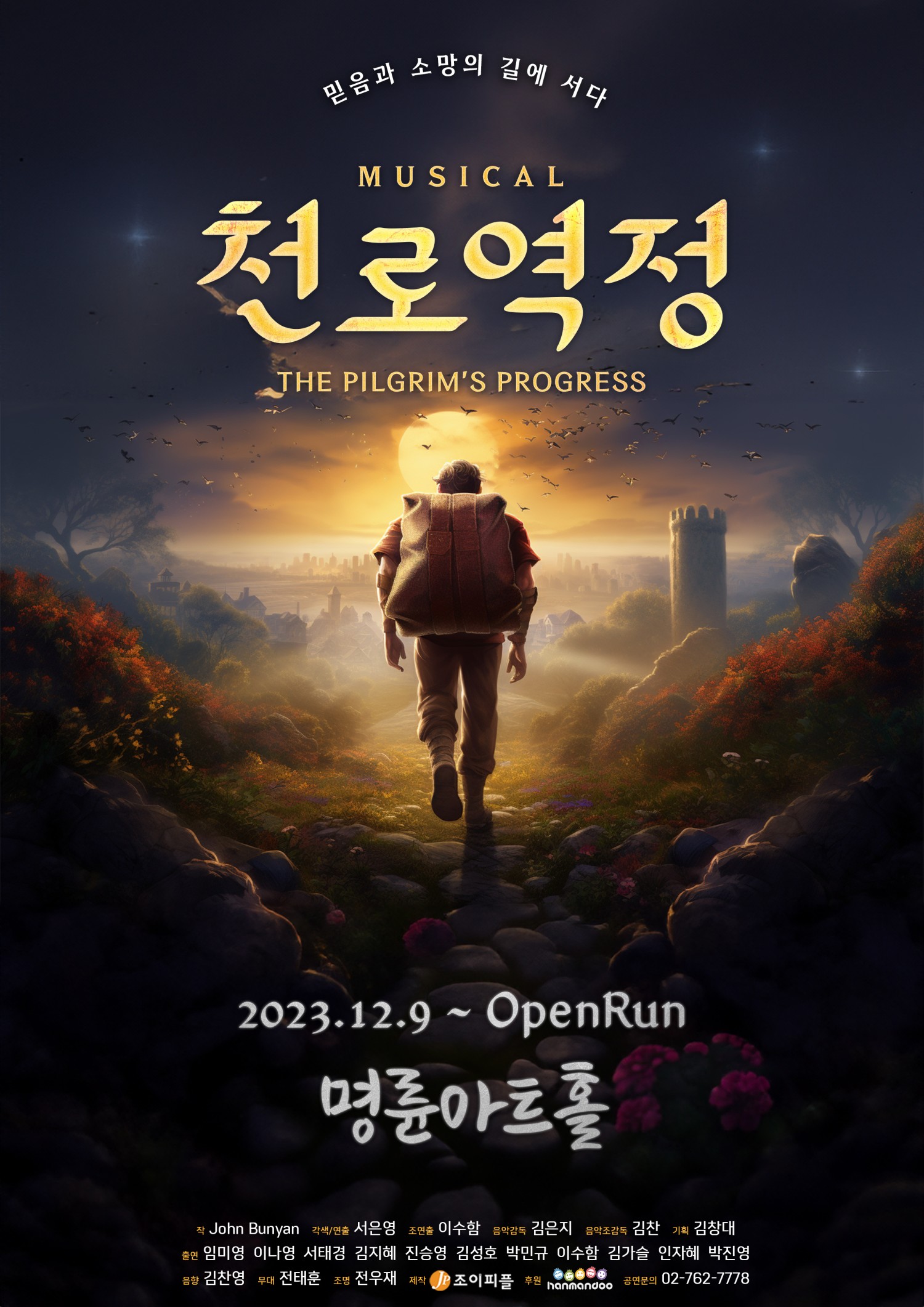
The Pilgrim's Progress
Dec 9, 2023 — Oct 31, 2026
Myeongnyun Art Hall, Seoul
ConcertMusicalOngoing
Inside Out
Jan 3, 2024 — Sep 27, 2026
JTN Art Hall (formerly Daehangno Art Madang) (Hall 2), Seoul
ConcertMusicalOngoing
Someday [Daehakro]
Mar 16, 2024 — Sep 30, 2026
Daehakno Muha Arts Center, Seoul
ConcertMusicalOngoing
Pinocchio, Let's Go! [Daehangno]
Mar 23, 2024 — Oct 31, 2026
Seoyeon Art Hall (formerly In'a Small Theater), Seoul
ConcertMusicalOngoing
Painters [Kyunghyang Art Hill]
Mar 25, 2024 — Oct 31, 2026
Gyeonghyang Art Hill (Hall 1), Seoul
Location
Arco Art Theater (Small Theater)아르코예술극장 (소극장)
See all events at Arco Art Theater (Small Theater) →
서울특별시 종로구 대학로8길 7 (동숭동)